 Need a professional advisor?

Our work
Evidence from the ground, delivered to the people who decide.
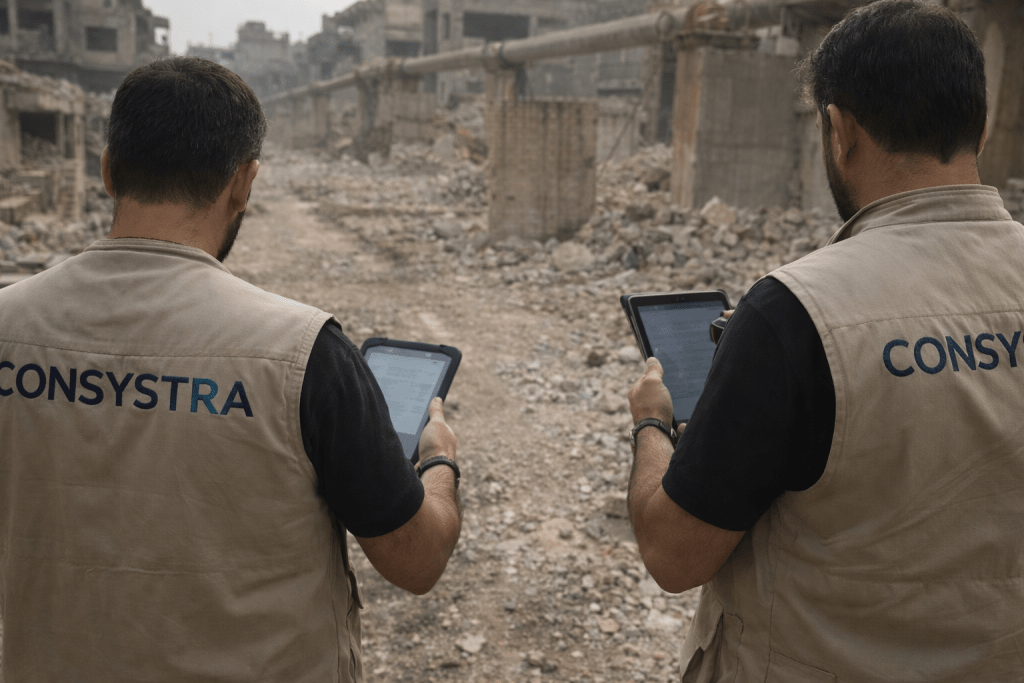
CONSYSTRA works where access is hard and the stakes are high. Our teams design research with communities, verify what donor-funded programmes deliver, and turn field evidence into findings that partners can act on. These engagements show how we do it: presence across Syria, international methodological standards, and strict protection of the people who speak to us.
Research and peacebuilding
Building Bridges: Seven Governorates, One Conversation
Community dialogue with 700 Syrians on trust, justice and reconciliation, distilled into more than 250 pages of research and a shared path toward community-led healing.
Dialogues held in
- Damascus
- Aleppo
- Homs
- Hama
- Latakia
- Raqqa
- Deir Ezzor
Overview
Syria’s transition depends on more than institutions. It depends on whether communities believe they are heard. Building Bridges brought Syrians from every background into one structured conversation on trust, justice and reconciliation, across seven governorates.
CONSYSTRA led the research, with our founder Muhammad Alothman serving as Lead Researcher. We designed and facilitated the dialogues and mediation workshops, analysed the testimony, and produced the integrated findings, in partnership with GIZ and International Humanitarian Relief.
How the work unfolded
-
Field dialogues
November 2025 – April 2026
56 community dialogue sessions and 7 community mediation workshops, with 100 participants in each governorate. Groups were balanced for sectarian and ethnic diversity, urban and rural backgrounds, gender, age and displacement experience.
-
Synthesis
Integrated analysis
One qualitative narrative analysis method, applied the same way at all seven sites, distilled thousands of words of lived testimony into the themes participants themselves named as most important. The result is more than 250 pages of thematic academic research reports.
-
Conference
Public launch of findings
The integrated findings were shared publicly, presenting the seven pathways communities identified for healing and five strategic moves grounded in the evidence.
What we found
Across all seven governorates, participants discussed transitional justice without calling for retribution, and debated the legitimacy of new governance structures with nuance. Each place added its own picture: in Raqqa, people described a “negative peace” of stability without security; in Hama, they divided over whether justice must come before reconciliation; in Deir Ezzor, they saw oil as both a source of division and a possible unifier. One message held everywhere: people want policies made with their communities, not about them.
The window to support community-led healing is open, but it will not stay open indefinitely.
Results
- An integrated evidence base on trust, justice and reconciliation covering seven governorates.
- Seven community-identified pathways for healing and five evidence-based strategic moves for decision-makers.
- Trained community mediators in every governorate who continue to apply their skills locally.
- More than 250 pages of thematic research reports, shared publicly at the launch conference.
“Now is when the bridges get built.”
Monitoring, evaluation and data collection
MENA MELS: Monitoring, Evaluation and Third-Party Data Collection in Syria
Field data collection and third-party monitoring across Syria, verifying how U.S.-funded humanitarian assistance reaches the people it is meant for.
Overview
MENA MELS is a U.S. Department of State-funded programme that provides independent monitoring, evaluation and learning across the Middle East and North Africa. In Syria, where access is limited and conditions shift quickly, the donor needs reliable, independent evidence on how its assistance is delivered.
CONSYSTRA partnered with MSI and AWRAD to carry out the fieldwork inside Syria. Our teams collected the data that underpins the programme’s monitoring and verification work.
What we do
- Real-time distribution monitoring. Observing aid distributions as they happen to verify targeting, process and conduct.
- Post-distribution monitoring. Following up with recipients to learn whether assistance arrived as planned, was appropriate, and met their needs.
- Site visits. Independent checks on health facilities and infrastructure projects in multiple regions.
- Mixed-methods data collection. Surveys, interviews and direct observation, carried out in person and remotely depending on access and security.
- Coverage across sectors. Health, education, protection, MHPSS, shelter and NFI, and nutrition.
Our approach
Independence and safety come first. Field teams are trained in conflict sensitivity, do-no-harm and PSEA, and respondent identities are protected throughout. Findings are cross-checked across observation, interviews and documentation before they are reported.
Results
- Independent evidence on humanitarian assistance delivery from across Syria.
- Stronger accountability to the donor and to the communities assistance is meant to serve.
- Early identification of gaps, so implementing partners can adjust while programmes are still running.
Our partners
We work alongside international agencies, research institutions and humanitarian organisations to deliver evidence that holds up.
Planning a programme, evaluation or monitoring assignment in Syria?
CONSYSTRA brings field access, rigorous methods and full respect for the people behind the data. Tell us what you need to know, and we will design the right way to find out.